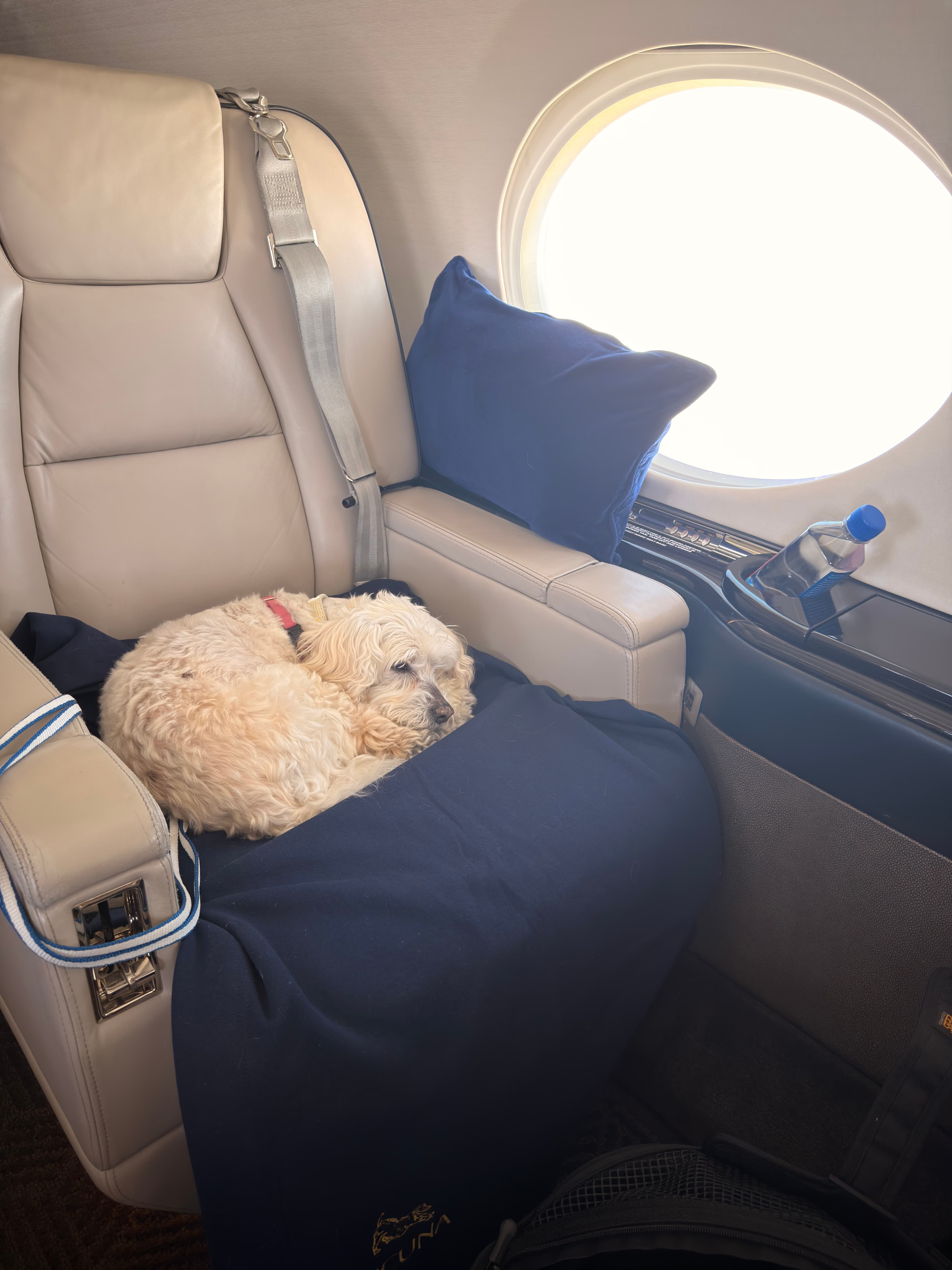
Last reviewed: 23 July 2026. Checked directly against current CDC and USDA APHIS guidance for non-commercial dog travel from the UK to the United States.
If you are planning to fly with your dog from the UK to the United States, you have probably started looking into the documentation and found that there is rather a lot to get your head around. The good news is that you are in exactly the right place.
This guide covers non-commercial dog travel from the UK to the United States by air, meaning your dog is travelling as a personal pet and not for sale or resale.
Fortunately, the UK is classed as a low-risk country for dog rabies so the process is generally much more straightforward than it would be travelling from a high-risk country. That said, there are still a few important requirements to get right and some easy mistakes that can cause unnecessary problems.
Please note that if your dog has spent time in a high-risk rabies country, different rules apply – check with us or with a vet for more information!
With that covered, let’s get into exactly what you will need and when you need to arrange it.
The documents you need
For a non-commercial dog travelling from Great Britain into the United States, the core documents and records to prepare are:
• your dog’s microchip details
• a current, valid rabies vaccination certificate;
• a CDC Dog Import Form receipt, completed online before departure;
• any veterinary health certificate or fit-to-fly certificate required by your airline, charter operator or destination state.
Because the UK is considered a low-risk country for dog rabies, the CDC Dog Import Form is the only document required under the standard federal CDC rules, provided your dog has not spent time in a high-risk country during the six months before entering the United States.
However, individual states and carriers can impose additional requirements. This means that, in practice, you more often than not still need evidence of a current rabies vaccination and a recent veterinary health certificate.
The CDC Dog Import Form receipt must be shown to the airline before boarding and kept available for U.S. Customs and Border Protection on arrival. This can either be carried as a print-out or just on your phone – though we would recommend saving a copy offline, just in case!
Step 1: Check your dog's age and microchip
There are two baseline requirements that apply to every dog entering the United States, regardless of route or vaccination history.
1. Your dog must be at least 6 months old on arrival. This is a hard rule with no exceptions – a dog under 6 months cannot enter the United States regardless of any other documentation.
2. Your dog must also be identifiable by microchip. Unlike travelling from the US into the UK, this doesn’t have to be an ISO-compliant microchip, but it must be detectable using a universal scanner.
Step 2: Check the rabies vaccination status and certification
Although the US doesn’t require a valid rabies certificate at the federal level for travel from the UK, most of the US does require one at the state level.
For the rabies vaccination itself, your dog must have received it after 12 weeks of age. The first vaccine is called a ‘primary’ dose and is valid for 1 year. Any subsequent vaccines issued within the previous vaccine’s validity period are usually counted as ‘booster’ doses and are valid for 3 years (depending on which exact product is used).
The rabies certificate must clearly show:
• The correct microchip number;
• The product name, manufacturer, and batch number of the rabies vaccine;
• The date of vaccination;
• The vet's signature and clinic stamp.
Small differences matter here; a microchip number that doesn't match what's on the CDC form, a vaccine brand written inconsistently across documents, or a missing batch number can all cause problems at the border – the absolute last thing anyone wants!
*A note on Massachusetts and Hawaii:
Massachusetts has stricter import rules than many other states. Dogs entering the state generally need a health certificate and evidence of rabies vaccination within the previous 12 months, even where a three-year vaccine may still be recognised elsewhere. Hawaii has a substantially more complex import process and should be planned separately. Always check the rules for the specific state in which your dog will first arrive.*
Step 3: Complete the CDC Dog Import Form
This is the main entry document for dogs travelling into the United States, and it works slightly differently from a health certificate. It is completed online through the CDC's own portal (found here) by the person importing the dog, rather than being issued by a vet. Once the form has been submitted, a receipt is sent by email.
The form is free to complete and takes just a few minutes. The receipt must be shown to the airline before boarding and to US Customs and Border Protection on arrival – printed or on a phone. Each dog needs its own form.
Step 4: Fit-to-Fly health certificate
At the federal level, the CDC does not require a vet-issued health certificate for dogs travelling from a low-risk country like the UK. For this route, the CDC Dog Import Form receipt is the principal federal document.
However, most airlines and some states require a health certificate or “Fit-to-Fly” certificate issued by a vet as their own condition of travel. The timeframe and information required can vary, so it is important to check directly with your carrier and review the rules for your destination state well in advance. For Vicuna flights, we provide a template for a Fit-to-Fly certificate for your vet to complete within 10 days of travel.
Common mistakes
The same handful of issues cause most of the problems we see on this route:
• Confusing the CDC form with a health certificate – they are separate documents, completed by different people and for different purposes. Where both are required, one does not replace the other.
• Entering mismatched microchip numbers - the number on the CDC form should match the number shown on the rabies certificate and any other veterinary documentation.
• Attempting to travel with a dog under six months old - this is a firm CDC requirement, with no exception or workaround.
• Failing to check the destination state’s rabies and health-certificate rules - federal entry requirements are only one part of the picture, and individual states may impose additional conditions.
• Overlooking the carrier’s own documentation requirements - even where the CDC does not require a health certificate, your airline or charter operator may still ask for one.
Fortunately, having read this guide, you now know exactly which areas require the closest attention. And if you are travelling with Vicuna, there is no need to navigate it alone: we will guide you through each stage, check the documents with you and help ensure there are no unwelcome surprises at check-in or at the border!
Sources
This guide is checked directly against CDC's dog importation guidance (current as of 22 July 2026, including the February 2026 form system update) and USDA APHIS guidance for pet travel. CDC requirements are updated periodically – we'll keep this page current as rules change.
For questions about your dog’s specific situation, contact Vicuna’s documentation team at fly@vicunaair.com or give us a call on +44 7497 920860