When a pet travels in the hold of a commercial aircraft, most people would describe it as "flying cargo". In US aviation language, however, there is an even starker term for this journey: accompanied baggage.
It’s an uncomfortable phrase, but a useful one. It reveals something about how pets are treated within the cargo air travel system. Once an animal is checked in, they are no longer beside their owner, visible to a crew member, or able to be comforted if something goes wrong. They become part of a handling process built around movement, logistics and custody – not companionship.
That does not mean every hold journey is dangerous; many pets fly this way every year and arrive safely. The public data does not report that serious incidents are common in absolute terms, but many owners agree that a low rate of reported incidents is not the same as an acceptable risk, especially for an animal that cannot readily communicate distress or advocate for itself.
This article looks at the public data we do have: the animal incident reports published by the US Department of Transportation’s Office of Aviation Consumer Protection in the Air Travel Consumer Report. These reports record deaths, injuries and losses involving animals transported by covered US airlines. They aren’t a perfect measure of pet welfare, and they don’t tell the whole story. In fact, their limitations are a fundamental part of the story.
The data shows a recurring pattern: the most serious risks appear when animals are out of sight, moving through a handling chain, or beyond immediate human response. That is the real concern with hold travel – not that it always goes wrong, but that when it does, help may not be close enough.
What the public data can – and cannot – tell us
The US Department of Transportation has required airlines to report incidents involving the loss, injury or death of animals during air transport since 2005, under 14 CFR Part 235. The rules were expanded significantly in January 2015, when they began applying to all US carriers operating scheduled service with at least one aircraft designed to carry more than 60 passengers. That change nearly doubled the number of covered carriers and brought commercial cat and dog shipments into the reporting system for the first time.
The important point is what the dataset actually measures. DOT records incidents involving animals during “air transport”, meaning the period when the animal is in the custody of a covered US air carrier. Ordinary in-cabin pets travelling beside their owner are generally outside this reporting universe, because the airline does not take custody of them in the same way.
That means the DOT data is best understood as a record of what happens once animals leave direct owner control and enter the airline handling system.
It is also a narrower dataset than many people realise. Foreign carriers are excluded, even when they operate flights that begin or end in the US. All-cargo flights and unscheduled charter operations are also outside the dataset. This matters because a significant amount of international pet transport moves through exactly these channels: freight carriers, charter operators and non-US airlines.
The data also cannot produce a clean comparison between cabin and hold travel. Ordinary in-cabin pets are generally outside the reporting universe, and the published annual totals do not provide separate denominators for checked-baggage pets and live cargo shipments. In simple terms, the DOT data can tell us something important about airline custody and handling, but it cannot tell us everything about pet welfare in flight.
Finally, it is worth noting that no equivalent reporting system exists anywhere else in the world. The UK, the EU, and other major aviation jurisdictions do not require airlines to publish comparable animal incident data. What follows is based on everything that is publicly available, because for now, this is all there is.
The numbers may be low, but the trend is revealing
Across the eleven years from 2015 to 2025 (the period for which complete annual figures are available from primary DOT sources) covered US carriers reported approximately 258 incidents across approximately 3.57 million animals transported.
In absolute terms, that is a low reported incident rate. But the headline rate should be read alongside another, more revealing trend: the total number of animals transported under the DOT reporting system has fallen sharply, from more than 500,000 annually before 2018 to 117,861 in 2025.
That is not just a statistical detail. It reflects a wider shift in airline policy. Several major US carriers have restricted, suspended or ended hold pet travel altogether, meaning fewer animals are now being carried in the categories the DOT tracks. In 2025, carriers including Allegiant, Frontier, JetBlue, Southwest and Spirit reported zero animals transported under the DOT animal-reporting system.
Delta Air Lines stopped accepting pets travelling as checked baggage in the hold in March 2016, after a period in which Delta recorded 74 pet deaths between 2005 and 2015 under the mandatory DOT reporting system. At that point, Delta moved the service into its Delta Cargo division under more structured conditions. More recently, Delta has ceased civilian pet shipments, with exceptions for active US military and Foreign Service Officers.
American Airlines and United Airlines have also introduced significant restrictions on checked-baggage pets, with their own breed exclusions, temperature restrictions and route limitations. Several major carriers have removed brachycephalic breeds (snub-nosed breeds such as bulldogs, pugs and Boston terriers) from hold eligibility entirely.
We cannot know precisely how each airline weighed safety, liability, logistics and commercial demand when making those decisions. But the direction of travel is significant. Hold pet transport has become less available, more restricted and, in many cases, no longer treated as a standard passenger service. That can reasonably be read as a risk signal: for many airlines, transporting pets in the hold appears to have become a service who’s operational and welfare risks are increasingly difficult to justify.
Where the risks of hold-travel lie
The risk in hold travel is not only the aircraft hold itself. It is the whole handling chain around it.
Since airlines began filing mandatory reports, documented incidents have included animals left on tarmacs for extended periods, pets placed on incorrect flights, carriers dropped or damaged during ground handling, animals escaping in cargo areas, and exposure to extreme temperatures during loading and unloading.
These incidents do not all share a single point of failure. They share a condition: the animal was outside direct human view, moving through a handling chain, and dependent on someone noticing a problem in time to act.
A pet travelling in the hold passes through more hands and more transitions than one travelling in the cabin: check-in, kennel inspection, ground transfer, loading, unloading, transfer to a holding area, and collection. Each point creates another opportunity for delay, mishandling or miscommunication.
Temperature is part of that risk, but again, it is not only about the time in the air. Animal cargo spaces on commercial aircraft are regulated, but the journey includes ground handling, loading, unloading, taxi, delays and time between flights. During those stages, the animal’s welfare depends on every part of the process being managed correctly.
Brachycephalic breeds face particular risk because their anatomy already compromises respiratory efficiency and temperature regulation. Stress and altitude can compound that. According to data compiled by the DOT, brachycephalic dogs represent about half of the dogs that die while being transported by their owners as cargo.
The point is not that hold travel is categorically dangerous in every case. It is that the points of greatest risk tend to be the points where the animal is least visible and least able to be helped immediately.
Senior dogs can face additional risk for a different reason. Age alone does not make a dog unfit to fly, but older dogs are more likely to have underlying heart, respiratory, kidney or mobility issues that may make air travel harder to tolerate. Dogs with underlying medical conditions, including heart or respiratory disease, are among those at greatest risk during air travel. In the hold, those risks are harder to monitor because the dog is out of sight and beyond immediate care. For senior dogs, the pre-flight vet check should therefore be more than paperwork: it should ask whether the dog is genuinely fit to cope with stress, confinement, temperature changes and delayed access to help.
The point is not that hold travel is categorically dangerous in every case. It is that the points of greatest risk tend to be the points where the animal is least visible and least able to be helped immediately.
What the data misses: stress, fear, and behavioural change
The DOT data records deaths, injuries and losses. It does not record fear, distress or behavioural change.
A pet that arrives alive but frightened, unsettled or visibly traumatised does not generate a DOT incident report unless there has been a reportable death, injury or loss. For owners, however, that kind of experience still matters. It may not appear in the public dataset, but it is part of the welfare question.
This is particularly important because flight stress does not always end when the aircraft lands. In one 2023 study, 13.8% of owners said their dog developed a behavioural problem within three months of flying, including separation anxiety and general anxiety. A further 10.4% reported a worsening of an existing behavioural problem.
These figures don’t mean every pet will be traumatised by air travel, but they show how welfare cannot be measured only by whether an animal physically survives the journey.
What in-cabin travel changes
In-cabin travel does not eliminate stress, but it changes several of the conditions that create the most serious risk.
The animal remains in a pressurised, temperature-controlled, human-occupied environment. If a dog is distressed, that distress is visible. If something unexpected happens, a person is present. The number of handling transitions is also greatly reduced: there is no separate cargo loading process, no transfer to a hold, and no waiting for collection in a separate area on arrival.
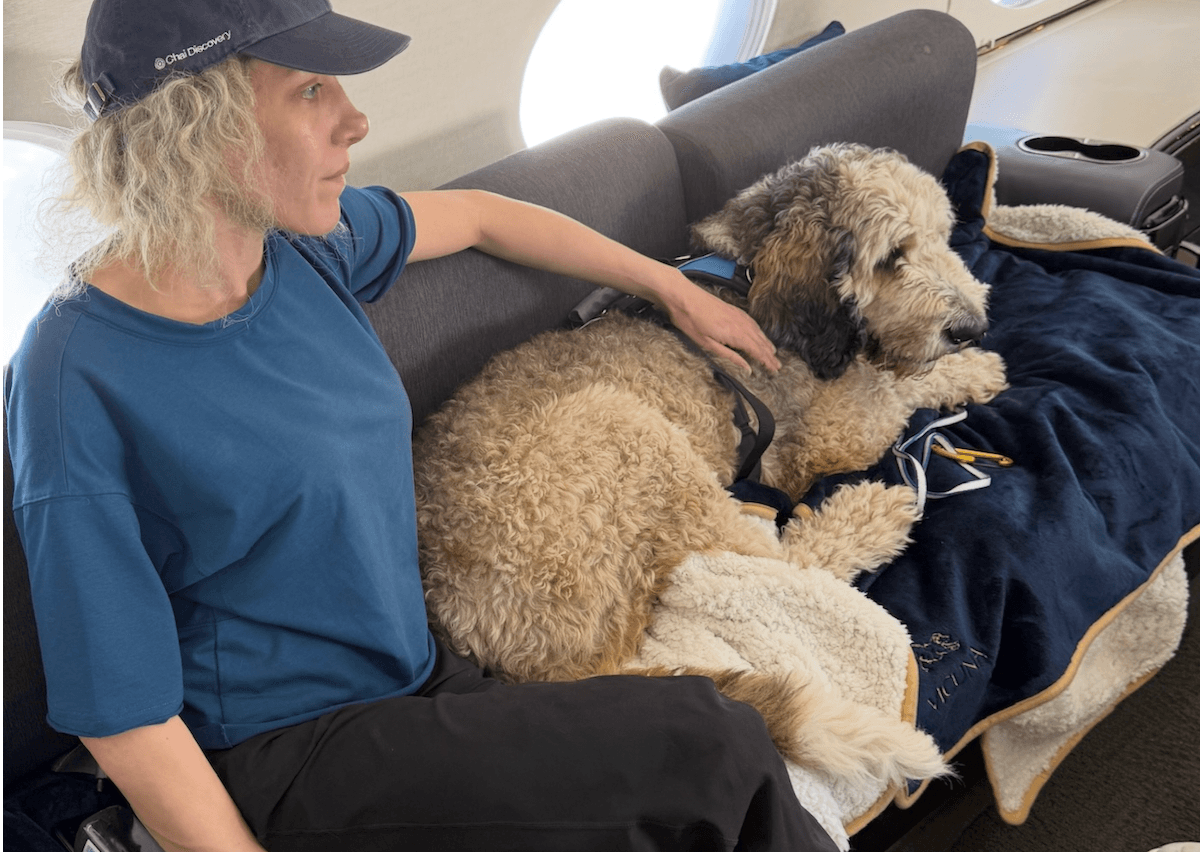
For animals travelling with their owner, proximity itself can be reassuring: a familiar scent, a familiar voice and the presence of the person they trust most. For animals travelling without their owner on Vicuna’s Biscuit Class service, a dedicated crew member is present throughout the journey to provide calm, continuity and supervision.
That does not mean every dog will find flying easy. But it does mean the animal remains visible, accompanied and able to be responded to throughout the journey. Several of the most stressful and least controllable parts of hold travel are either removed or significantly reduced.
Low rate is not the same as acceptable risk
Many pets fly in the hold every year without incident. The DOT incident rate, in absolute terms, is low. We are not suggesting otherwise.
But a low rate and an acceptable risk are not the same, especially when the decision is being made for an animal that cannot communicate distress, cannot consent and cannot advocate for itself.
The question is not only whether hold travel usually goes fine, but rather what happens when it doesn't - and whether anyone is close enough to notice, understand and intervene.
Across the incident record, airline policy decisions and the physiological reality of animal stress, the same pattern appears: the risk in hold transport is not random or evenly distributed. It concentrates at the points where the animal is out of sight, moving through a handling chain, or beyond immediate human response.
Cabin travel changes that process. It keeps the animal visible, in a human-occupied environment, with someone present to notice distress and respond. For owners deciding how their pet should travel, that difference is not a luxury. It is the whole point.